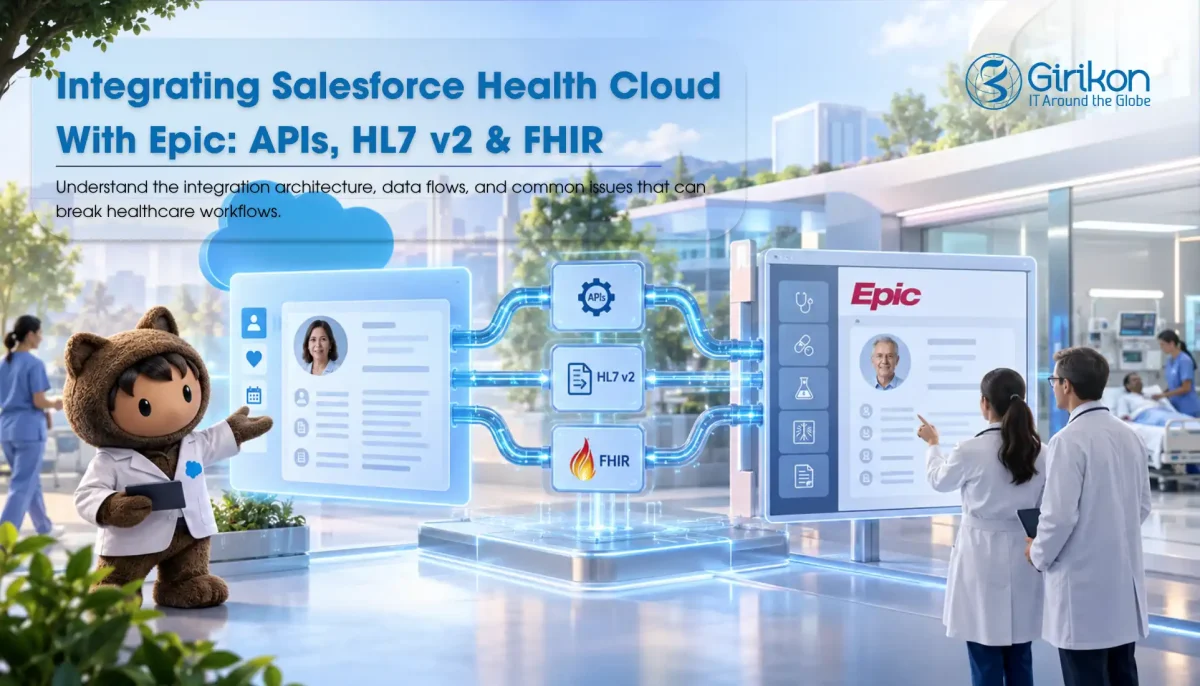
Healthcare organizations using Epic need clinical data available in Salesforce in a way that avoids fragmented records and workflows that fail under production volume. This requirement defines most Salesforce Epic integration projects. There are two ways healthcare providers can integrate: HL7 v2 and FHIR, each with their own benefits. You must know the best-case scenarios for both, if used incorrectly, can result in inaccurate data and create compliance risks.
So, which is the better approach? When to use HL7 and where FHIR delivers better results. If you’re wondering about these questions, then this blog is for you. In this blog, we explore in detail about these integration paths. In addition, we’ll also share a few best practices to avoid Epic EHR integration failures while building reliable, scalable architectures for Salesforce Health Cloud.
What’s inside
What is Salesforce Epic Integration in Healthcare?
HL7 v2 vs FHIR APIs: Which is Better Integration Approach to Use?
How FHIR APIs Connect Epic and Salesforce Health Cloud
How to Do Salesforce Epic Integration Successfully for Healthcare Organizations
Conclusion
What is Salesforce Epic Integration in Healthcare?
Salesforce Epic integration allows connection of the clinical and administrative data with Salesforce Health Cloud. This enables healthcare providers with a unified view of patient information, interactions, and other details within the platform. It includes HL7 v2 messaging, FHIR APIs or both, providing a safe and a HIPAA-compliant real-time data sharing.
How Does Salesforce Integrate with Epic?
Health Cloud EHR integration isn’t about just copying Epic records into Salesforce. It is an ongoing process with data flowing in real time, gets mapped to the right objects, and stays sync as records change on either side. Few use cases:
Patient and demographic sync keep names, contact details, and patient identifier reconciliation aligns across systems, reducing duplicate or mismatched records.
Encounters and clinical information give care coordinators visibility into visits, diagnoses, and treatment history without logging into Epic directly.
Care management teams use synced data to build care plans and track interventions inside Salesforce.
Provider information feeds referral workflows and directory accuracy.
Patient engagement tools draw on Epic data to personalize outreach and communication.
Contact-center workflows rely on accurate, current patient data, so agents aren’t working from outdated records.
What is HL7?
HL7 v2 or Health Level 7 is a messaging standard used across healthcare systems, including Epic. It’s a very old system to exchange operational events like admissions, transfers, discharges, orders, and results. HL7 is message-based rather than resource-based, which means each event triggers a discrete, structured message rather than a query against a shared data model.
When to Use Specific HL7 Standards
For admission, discharge, and transfer (ADT) feeds
Apply HL7 v2 for lab results and diagnostic reports
To trigger real-time clinical event notifications
Billing and insurance claim messages
Utilize HL7 v2 when hospital systems depend on legacy interfaces
When to avoid HL7 v2:
Skip HL7 v2 when projects demand modern, API-driven interoperability. Its rigid text-based format and custom “Z-segments” make cross-system mapping error-prone, especially in cloud or mobile environments.
What are FHIR APIs?
FHIR, or Fast Healthcare Interoperability Resources, is a set of basic standards applied in an API manner to structure health records into resources, like Patient, Encounter or Condition. Typically, systems use REST APIs to request or subscribe to specific resources to communicate instead of sending event messages. This is because these APIs are more suitable for modern apps than older messaging formats.
What is the FHIR API standard used for?
Use it for patient demographics and records retrieval
To manage care plans and medication
Best for mobile health apps and patient portals
For keeping analytics and population health dashboards
Need secure, modular data exchange across systems
When to avoid Salesforce FHIR integration:
Avoid Salesforce FHIR integration when hospital systems haven’t fully implemented the standard or only support partial resources. In such cases, depending on FHIR can lead to gaps in data exchange, and you’d need HL7 v2 to work without friction.
HL7 v2 vs FHIR APIs: Which is Better Integration Approach to Use?
Factor
HL7 v2
FHIR APIs
Data modelMessage-basedResource-based
CommunicationEvent/message drivenAPI/request driven
Typical useOperational eventsApplication/data access
Data exchangeStructured messagesJSON/XML resources
Best fitReal-time event notificationsModern application workflows
Integration challengeParsing/mappingAPI, authorization, terminology
Swipe horizontally to see all columns →
Is FHIR better than HL7 v2 for Epic Integration?
No. Each has their own benefits, and at times enterprises need both. HL7 v2 handles the operational event stream; using Salesforce FHIR integration can support the modern application layer. You cannot consider one integration path as a complete substitute for another and may need both to operate without delays or compliance risks.
How FHIR APIs Connect Epic and Salesforce Health Cloud
FHIR APIs connect Epic and Salesforce Health Cloud by exposing structured healthcare resources such as Patient, Encounter, and Condition through Epic’s FHIR program. Secured with OAuth, the Salesforce Healthcare API consumes these resources to enable consistent data exchange. This supports standard Salesforce FHIR integration patterns, reducing complexity compared to custom frameworks, and strengthening overall Health Cloud EHR integration reliability.
Where HL7 v2 Fits in a Salesforce Epic Integration Architecture
HL7 v2 drives event-based workflows: ADT messages, encounter updates, patient transfers, orders, and results. These events must reach Salesforce quickly and without data loss, which is where an integration platform becomes essential. MuleSoft, particularly MuleSoft Direct for Health Cloud, transforms HL7 v2 messages before they enter Salesforce. It converts raw segments into structured records that align with Health Cloud objects. This segment-to-object mapping is where most engineering effort lies, and it’s not what Salesforce was designed to handle natively.
The integration layer should own transformation, routing, monitoring, error handling, and orchestration. Salesforce documentation highlights MuleSoft’s ability to process both HL7 v2 and FHIR data for Health Cloud, underscoring that this division of responsibility is fundamental to the architecture.
How to Do Salesforce Epic Integration Successfully for Healthcare Organizations
Step 1: Define Integration Pattern
Understand where you should opt for HL7 v2 and where it’s better to use FHIR. It should be clearly documented as well. Understand where you should opt for HL7 v2 and where it’s better to use FHIR. It should be clearly documented as well. Clarity in choosing the right option: HL7 v2 vs FHIR lets you avoid working with fragmented systems, poor data flows, and patchwork integrations which are difficult to maintain after going live. In addition, having an Salesforce governance framework early also helps align roles and controls before integration decisions are finalized.
Step 2: Reconcile Patient Identifiers
Any duplicity or mismatch issues in patient identifiers leads to errors across care, billing, and reporting processes. So, set up a patient identifier reconciliation framework before adding new workflows. A poor identity management will make downstream correction costly and time-consuming, if you already start using records.
Step 3: Centralize Transformation Logic
Handling transformation in MuleSoft or another integration platform will be more ideal than in Salesforce. This architecture enhances the scalability, maintenance procedures, and separation of responsibilities within interconnected systems by keeping this logic separate. Using MuleSoft Direct for Health Cloud prevents mapping overload in Salesforce and supports long-term reliability across complex Epic EHR integration projects.
Step 4: Standardize Terminology Codes
Code sets vary across source systems, and inconsistencies degrade data quality. Therefore, make normalization part of design, and not as a cleanup later. Having it embedded in the architecture allows you to facilitate consistent reporting, reliable analytics, and smoother clinical workflows in Salesforce HL7 integration environments.
Step 5: Embed Monitoring Controls
Silent failures bring in compliance risk and can compromise patient care. But when you’ve visibility across the integration pipeline, issues can be detected quickly and get resolved before they escalate. Therefore, built monitoring and alerting systems into the architecture from the beginning for better detection and faster resolution across the Health Cloud EHR integration process.
Step 6: Test Failure Scenarios
Integration processes can face issues like incomplete data exchange, inaccurate, or delay in connection. Define handling rules for each case and test them before go-live. Teams that validate only successful transactions often miss critical Epic EHR integration failure points, creating risks for patient safety and regulatory compliance.
Step 7: Align Security Standards
Review Salesforce security posture at the planning stage and confirm Salesforce HIPAA compliance before patient data is exchanged. Adding controls after deployment is significantly more difficult. Ensure access policies meet other major regulatory requirements from the outset; it reduces risk and enables smoother audits once Health Cloud EHR integration is live.
Step 8: Validate Interface Specifications
Epic’s HL7 feeds often differ from generic specifications. Confirm interface details with each source system before building workflows. Assuming standard compliance results in failed transactions, inconsistent data exchange, and costly rework once integrations are already deployed.
Step 9: Strengthen Authorization Setup
OAuth configuration frequently fails under load. Configure authorization carefully and test token refresh in realistic conditions. Weak setup causes session drops, blocked transactions, and security gaps that disrupt Health Cloud EHR integration workflows and compromise compliance once patient data begins flowing.
Step 10: Replace Point-to-Point Links
Point to point connections are not scalable. Employ an integration platform to control routing and transformation centrally. Direct links lead to fragile architectures, increase maintenance costs, limit scalability by injecting additional systems and processes into the architecture over time.
Conclusion
Effective Salesforce Epic integration is more than just selecting between HL7 v2 vs FHIR. Organizations need clarity on which problems each standard addresses and where both must operate together. Success depends on strong patient identity reconciliation, disciplined terminology management, and a capable integration layer. With these foundations in place, healthcare teams gain reliable data flows that support clinical accuracy, compliance, and scalable Health Cloud EHR integration.
.gkh-blog{
--gkh-accent:#1a73e8; --gkh-dark:#0f4fa8; --gkh-light:#e8f0fe; --gkh-hl:#f3f7ff;
--gkh-line:#e4e9f2; --gkh-ink:#101828; --gkh-body:#3f4a5a; --gkh-mute:#697586;
--gkh-ok:#0f7a4a; --gkh-ok-bg:#eefaf3; --gkh-ok-line:#c3ead6;
--gkh-warn:#a35c00; --gkh-warn-bg:#fff8ec; --gkh-warn-line:#f5dfb8;
--gkh-r:10px;
font-size:17px; line-height:1.75; color:var(--gkh-body);
-webkit-font-smoothing:antialiased;
}
.gkh-blog *,.gkh-blog *::before,.gkh-blog *::after{box-sizing:border-box;}
.gkh-blog p{margin:0 0 20px;}
.gkh-blog h2{
position:relative; font-size:29px; line-height:1.3; letter-spacing:-.015em;
margin:56px 0 18px; padding-top:16px; color:var(--gkh-ink); font-weight:700; scroll-margin-top:90px;
}
.gkh-blog h2::before{
content:""; position:absolute; top:0; left:0; width:46px; height:4px; border-radius:3px;
background:linear-gradient(90deg,var(--gkh-accent),#5fa0f5);
}
.gkh-blog h3{font-size:20px; line-height:1.38; letter-spacing:-.01em; margin:34px 0 10px; color:var(--gkh-ink); font-weight:700; scroll-margin-top:90px;}
.gkh-blog h4{font-size:16.5px; line-height:1.4; margin:0 0 10px; color:var(--gkh-ink); font-weight:700; scroll-margin-top:90px;}
.gkh-blog h2 + p,.gkh-blog h3 + p{margin-top:0;}
.gkh-blog img{max-width:100%; height:auto; display:block; margin:0 auto; border-radius:var(--gkh-r);}
.gkh-blog hr{border:0; border-top:1px solid var(--gkh-line); margin:44px 0;}
.gkh-blog ul,.gkh-blog ol{margin:0 0 22px; padding:0; list-style:none;}
/* ---- links ---- */
.gkh-blog a{
color:var(--gkh-accent); font-weight:600;
background-image:none !important;
text-decoration:underline !important;
text-decoration-thickness:1px; text-underline-offset:3px;
text-decoration-skip-ink:auto;
transition:color .15s ease, text-decoration-thickness .15s ease;
}
.gkh-blog a:hover,.gkh-blog a:focus-visible{color:var(--gkh-dark); text-decoration-thickness:2px;}
.gkh-blog a:visited{color:var(--gkh-accent);}
.gkh-toc-list a{text-decoration:none !important;}
.gkh-blog a:focus-visible{outline:2px solid var(--gkh-accent); outline-offset:3px; border-radius:3px;}
/* ---- keyword ---- */
.gkh-kw{color:var(--gkh-ink); font-weight:700;}
/* ---- lede ---- */
.gkh-lede{
background:var(--gkh-hl); border-left:4px solid var(--gkh-accent);
border-radius:0 var(--gkh-r) var(--gkh-r) 0;
padding:20px 24px; margin:0 0 26px; font-size:18px; line-height:1.7; color:var(--gkh-ink);
}
.gkh-lede p{margin:0;}
/* ---- table of contents ---- */
.gkh-toc{
border:1px solid var(--gkh-line); border-radius:var(--gkh-r);
background:#fff; padding:20px 24px 8px; margin:30px 0 38px;
}
.gkh-toc-head{
font-size:11px; font-weight:700; letter-spacing:.11em; text-transform:uppercase;
color:var(--gkh-mute); margin:0 0 14px;
}
.gkh-toc-list{counter-reset:gkhtoc; margin:0; padding:0;}
.gkh-toc-list li{counter-increment:gkhtoc; position:relative; padding:0 0 12px 34px; font-size:15.5px; line-height:1.5;}
.gkh-toc-list li::before{
content:counter(gkhtoc,decimal-leading-zero);
position:absolute; left:0; top:1px;
font-size:11px; font-weight:700; color:var(--gkh-accent);
background:var(--gkh-light); border-radius:5px; padding:2px 6px; letter-spacing:.02em;
}
.gkh-toc-list a{color:var(--gkh-body); font-weight:600;}
.gkh-toc-list a:hover{color:var(--gkh-accent); text-decoration:underline !important;}
/* ---- chips ---- */
.gkh-chips{display:grid; grid-template-columns:repeat(2,minmax(0,1fr)); gap:10px; margin:22px 0 26px;}
.gkh-chips li{
display:block; position:relative;
background:var(--gkh-hl); border:1px solid var(--gkh-line); border-radius:8px;
padding:13px 16px 13px 34px; font-size:15px; line-height:1.6; color:var(--gkh-ink);
}
.gkh-chips li::before{
content:""; position:absolute; left:15px; top:21px;
width:6px; height:6px; border-radius:50%; background:var(--gkh-accent);
}
/* ---- split use / avoid panels ---- */
.gkh-split{display:grid; grid-template-columns:repeat(2,minmax(0,1fr)); gap:16px; margin:24px 0 30px; align-items:start;}
.gkh-sc{
position:relative; border:1px solid var(--gkh-line); border-radius:var(--gkh-r);
background:#fff; padding:22px 22px 18px; border-top:3px solid var(--gkh-accent);
transition:box-shadow .18s ease, transform .18s ease;
}
.gkh-sc:hover{box-shadow:0 8px 26px rgba(16,24,40,.08); transform:translateY(-2px);}
.gkh-sc-icon{
width:34px; height:34px; border-radius:8px; margin-bottom:12px;
display:flex; align-items:center; justify-content:center;
}
.gkh-sc-icon svg{width:19px; height:19px;}
.gkh-sc p{font-size:15.5px; line-height:1.68; margin:0;}
.gkh-sc-use{border-top-color:var(--gkh-ok); background:linear-gradient(180deg,var(--gkh-ok-bg) 0%,#fff 78px);}
.gkh-sc-use .gkh-sc-icon{background:#fff; border:1px solid var(--gkh-ok-line); color:var(--gkh-ok);}
.gkh-sc-avoid{border-top-color:var(--gkh-warn); background:linear-gradient(180deg,var(--gkh-warn-bg) 0%,#fff 78px);}
.gkh-sc-avoid .gkh-sc-icon{background:#fff; border:1px solid var(--gkh-warn-line); color:var(--gkh-warn);}
/* ---- tick list ---- */
.gkh-ticks{margin:0; padding:0;}
.gkh-ticks li{
position:relative; padding:0 0 11px 27px; font-size:15.5px; line-height:1.62; color:var(--gkh-body);
}
.gkh-ticks li:last-child{padding-bottom:0;}
.gkh-ticks li::before{
content:""; position:absolute; left:2px; top:7px; width:13px; height:8px;
border-left:2.5px solid var(--gkh-ok); border-bottom:2.5px solid var(--gkh-ok);
transform:rotate(-45deg); border-radius:1px;
}
/* ---- comparison table ---- */
.gkh-table-wrap{
overflow-x:auto; -webkit-overflow-scrolling:touch;
border:1px solid var(--gkh-line); border-radius:var(--gkh-r); margin:24px 0 10px;
}
.gkh-table{width:100%; border-collapse:collapse; min-width:560px; font-size:15px;}
.gkh-table th,.gkh-table td{padding:14px 16px; text-align:left; vertical-align:top; line-height:1.6;}
.gkh-table thead th{
background:var(--gkh-hl); color:var(--gkh-dark);
font-size:11.5px; font-weight:700; letter-spacing:.07em; text-transform:uppercase;
border-bottom:1px solid var(--gkh-line); white-space:nowrap;
}
.gkh-table tbody td{border-top:1px solid var(--gkh-line);}
.gkh-table tbody tr:nth-child(even) td{background:#fbfcfe;}
.gkh-table th:first-child,.gkh-table td:first-child{
position:sticky; left:0; z-index:1;
background:#fff; font-weight:700; color:var(--gkh-ink); font-size:14.5px;
border-right:1px solid var(--gkh-line);
}
.gkh-table thead th:first-child{background:var(--gkh-hl);}
.gkh-table tbody tr:nth-child(even) th:first-child{background:#fbfcfe;}
.gkh-tag{
display:inline-block; font-size:13px; font-weight:600; color:var(--gkh-dark);
background:var(--gkh-light); border:1px solid #d2e2fb; border-radius:6px; padding:3px 10px;
}
.gkh-table-hint{font-size:12.5px; color:var(--gkh-mute); margin:0 0 30px; text-align:right;}
/* ---- callout ---- */
.gkh-callout{
display:flex; gap:14px; align-items:flex-start;
border-radius:var(--gkh-r); padding:18px 22px; margin:20px 0 28px;
font-size:16px; line-height:1.7;
background:var(--gkh-hl); border-left:4px solid var(--gkh-accent); color:var(--gkh-ink);
}
.gkh-callout svg{width:20px; height:20px; flex:0 0 20px; margin-top:4px; color:var(--gkh-accent);}
.gkh-callout p{margin:0;}
/* ---- step timeline ---- */
.gkh-steps{position:relative; margin:28px 0 34px; padding-left:30px;}
.gkh-steps::before{
content:""; position:absolute; left:6px; top:10px; bottom:10px; width:2px;
background:linear-gradient(180deg,var(--gkh-accent),#bcd5f8 85%,transparent);
}
.gkh-step{position:relative; padding:0 0 10px;}
.gkh-step::before{
content:""; position:absolute; left:-30px; top:14px;
width:14px; height:14px; border-radius:50%;
background:#fff; border:3px solid var(--gkh-accent);
box-shadow:0 0 0 4px #fff;
}
.gkh-step h3{font-size:18.5px; margin:26px 0 8px; letter-spacing:-.005em;}
.gkh-step:first-child h3{margin-top:0;}
.gkh-step p{font-size:16px; line-height:1.72; margin:0 0 4px;}
/* ---- closing ---- */
.gkh-takeaway{
background:var(--gkh-hl); border:1px solid var(--gkh-line); border-radius:var(--gkh-r);
padding:22px 26px; margin:24px 0 22px;
}
.gkh-takeaway p{margin:0 0 14px;}
.gkh-takeaway p:last-child{margin:0;}
/* ---- responsive ---- */
@media (max-width:900px){
.gkh-blog h2{font-size:26px; margin-top:46px;}
}
@media (max-width:700px){
.gkh-split{grid-template-columns:1fr;}
}
@media (max-width:640px){
.gkh-blog{font-size:16.5px;}
.gkh-blog h2{font-size:23px;}
.gkh-blog h3{font-size:18.5px;}
.gkh-step h3{font-size:17.5px;}
.gkh-lede{font-size:17px; padding:17px 18px;}
.gkh-toc{padding:18px 18px 6px;}
.gkh-chips{grid-template-columns:1fr;}
.gkh-sc{padding:18px 18px 16px;}
.gkh-takeaway{padding:18px 18px;}
.gkh-callout{padding:16px 18px;}
.gkh-steps{padding-left:24px;}
.gkh-step::before{left:-24px; width:12px; height:12px;}
}
@media (prefers-reduced-motion:reduce){
.gkh-blog *{transition:none !important;}
.gkh-sc:hover{transform:none;}
}















 +1-480-241-8198
 +44-7428758945
 +61-1300-332-888
 +91 9811400594